
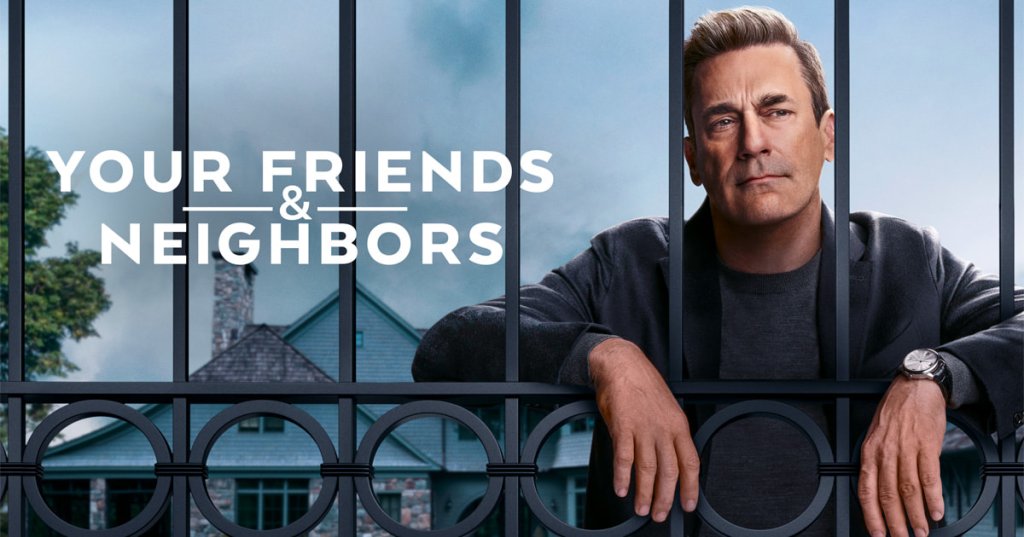
These days, when messages like “fuck the oligarchy” are splattered not only across the internet but city streets, you’d think a show like Your Friends and Neighbors on Apple TV+ wouldn’t land quite well. The series is set in the ultra-wealthy Westmont, a fictional suburb just outside New York City, and follows characters whose net worths likely start around $20 million. Not exactly the type of people the average viewer is rooting for in 2025, right?
Wrong. At least for me, and for the millions of other viewers who got the show renewed for a Season 2. Like most, I’m not part of the Maserati-driving, multiple-home-owning, country-club-attending elite. And that’s exactly why I like it. Sue me, but it’s both escapist and revealing. As a viewer, you sit on the couch after a long day and turn on the TV to clock out of your life and clock into someone else’s. With most shows about “aspirational” lives, you can find yourself watching in a state of envy. But through the tales of the friends and neighbors in this pretentious suburb, you start to realize their lives aren’t so enviable. In fact, they’re kind of miserable. And we can’t stop watching.
Andrew Cooper, played by Jon Hamm, is the protagonist of the show, and in the pilot episode, you learn he’s lost it all. His wife—to the ex-NBA player who lives a few doors down. His job—to a conniving boss at a successful hedge fund. And with it, part of his sanity, as he embarks on a journey of theft throughout the neighborhood simply to keep the rich ruse alive. Anyone who isn’t so desperate to keep up with the Joneses would probably handle getting fired a bit differently, to say the least. But Coop, who can’t bear losing more than he already has, would rather commit crimes than succumb to being relatively “poor.” He’s our tall, dark and handsome Walter White.
Then there’s Barney: his right-hand man, wealth manager, and best friend. Right away, you can tell these two aren’t shy about holding each other accountable and keeping it, for the most part, real. But like most shows about the elites, you realize that even though they’re close, they still have their secrets. Barney is in the midst of an expensive home remodel, simply to keep up with the demands of his wife, a Korean heiress to an immense fortune. From the outside, and to everyone around him, the remodel seems lavish. A symbol of success, if you will. On the inside, his desire to scale back on these money-draining projects is consistently shut down by her relentless craving for more and for better.
At first, these gripes can feel out of touch. And they are. But when you think about it, it’s just sad. It brings the idea of “more money, more problems” to life. Getting to the top makes the fall that much harder. While climbing, you lose your grip on reality, then on yourself, and before you know it, the joy’s slipped away too. I know that’s not exactly a relatable plight in a world where people can’t afford groceries, and Coop, Barney, is it really that difficult to just be honest? Tell the truth about your finances? Swallow some temporary discomfort to escape long-term, empty misery?
The problems of the wealthy feel insignificant next to the chaos of the real world, and yes, they make you think, “Kim, people are dying.” And I get it. But while we scoff, we still admire the perfectly manicured lawns their fictional mansions sit on. And as quickly as we judge, we hit the “Next Episode” button.
That’s because Your Friends and Neighbors is as self-aware as it is tone-deaf. Though Andrew Cooper refuses to downsize, through his downfall, all the glaring truths about how bleak and fake the life of the rich is aren’t lost on him. It’s also clear that Coop deeply loves his family and is desperate to protect the life they’ve grown used to.
Jon Hamm can’t help but bring humor to both the character and the show. It makes him sympathetic, someone you do end up rooting for even when you disagree with the lengths he’s willing to go to in the name of self-preservation.
The show maintains plenty of levity, even with its dark undertones. The stakes feel high. After all, Coop is stealing from the very people he plays golf with at the club, but not so high that you feel stressed during or after watching. And though it might not have you cheering for the one percent, it’ll let you in on some not-so-secret secrets: keeping up with the lap of luxury brings its own, albeit first-world, set of problems to the table. All those things you so desperately desire or want to achieve? They aren’t necessarily going to make you happier.
And the toughest truth of all, the one we don’t care to admit, is that we all love to hate, and hate to love, the rich.
Michelle Aguilar is a UW–Madison School of Journalism grad, pop culture enthusiast, and NYC-based salesperson. Follow her on Twitter @ItsMichAguilar and Instagram @michiaguilar.
 The Daily Drunk